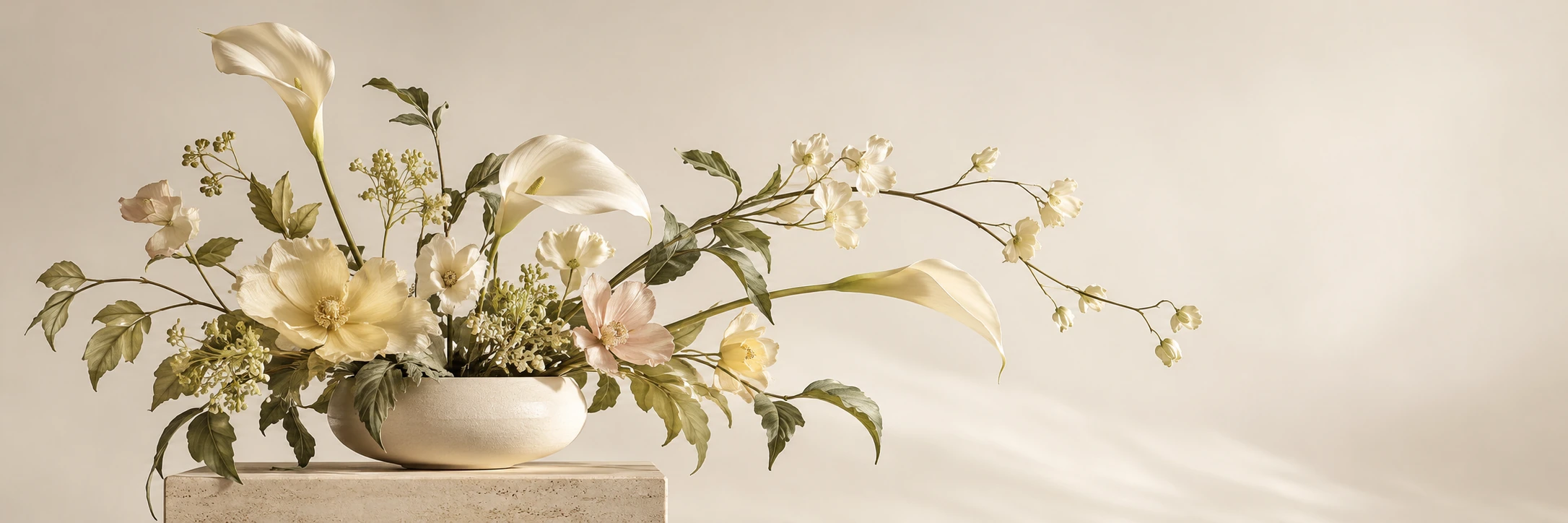

Check vessel dimensions, placement conditions and viewing distance separately for commercial interiors. A single image or style name can blur different parameters: overall height is not vessel height, vessel material is not floral composition, and a corner location needs a different assessment from a piece directly in view. This guide explains the checks only; specifications, quotations and delivery terms remain project-specific.
1. Separate the overall piece from its vessel
Artificial greenery dimensions involve at least overall length, width and height, the longest dimension, and vessel dimensions. None replaces the others, and one number alone is insufficient. If only overall height is given, do not assume the vessel changes proportionally. Styles sharing an image may have similar outlines but different vessel heights and openings, producing different results when placed.
Record overall length, width and height explicitly, the longest dimension, vessel height and opening, vessel material and floral material separately. If the three axes are unclear, do not infer orientation. Vessel material cannot stand in for floral composition; they are different fields.
Original categories such as “small”, “medium” and “large” are not a uniform size standard. Suppliers and styles may use different classifications. Compare actual dimensions rather than category names.
2. Placement defines the selection conditions
For placement, ask three questions first: can people touch the piece, will routine cleaning affect it, and do fixed furniture or structures limit it? A floor-level piece on a circulation route has different selection priorities from one high on a surface and out of easy reach.
Turn placement conditions into measurements: passage width, allowed base footprint, overhead obstructions, and proximity to entrances or service routes. These limit overall dimensions and may call for a more stable base. Agree who handles positioning, assembly and fixing; no division of supply and site work should be assumed.
Near windows or outdoor transition areas, include light, temperature and humidity conditions in the discussion. Do not assume unverified performance: being artificial does not establish sunlight resistance, fire retardancy, maintenance-free use or similar properties.
3. Viewing distance sets the level of detail to check
Viewing distance affects how to check stem form, layers of foliage and vessel surface details. State the main distance and angle before comparing complete photographs or samples. Fine detail may carry less weight at a distance; positions viewed closely and repeatedly need fuller checking.
Record the straight-line distance from the main viewing point, whether the view is level, downwards or upwards, and any chance of close-up photography or touching. These explain requirements to the supplier, not a fixed standard; the appropriate detail still depends on the style records and actual samples.
4. Bring the three elements into one checklist
- Dimensions: record overall length, width and height and the longest dimension separately from vessel dimensions
- Vessel: list height, opening and material separately; vessel material does not describe floral composition
- Placement: passage width, allowed footprint, overhead clearance and surrounding structures
- Viewing: distance and angle from the main viewing point, and possible close contact
- Environment: describe light, temperature and humidity accurately, without assuming performance
- Responsibilities: agree supply, remote guidance, positioning, assembly and fixing for the project
The checklist shifts selection from “choosing from an image” to “checking against conditions”. More specific entries give the supplier a clearer basis for recommendations and further discussions. The checklist itself is neither a quotation nor a lead-time commitment.
5. What must be confirmed for each project
Specifications, quotations, minimum quantities, lead times and applicable conditions must be confirmed for the project; this guide gives no figures or commitments. If supply with remote installation guidance is agreed, settle site and delivery responsibilities beforehand. No single arrangement applies to every project.
For interior designers and commercial procurement teams, separating vessel, placement and viewing distance is more useful in reducing rework than repeatedly comparing style images. Clarify the conditions first, then judge the styles on a firmer basis.